Period:April 2014 - June 2017
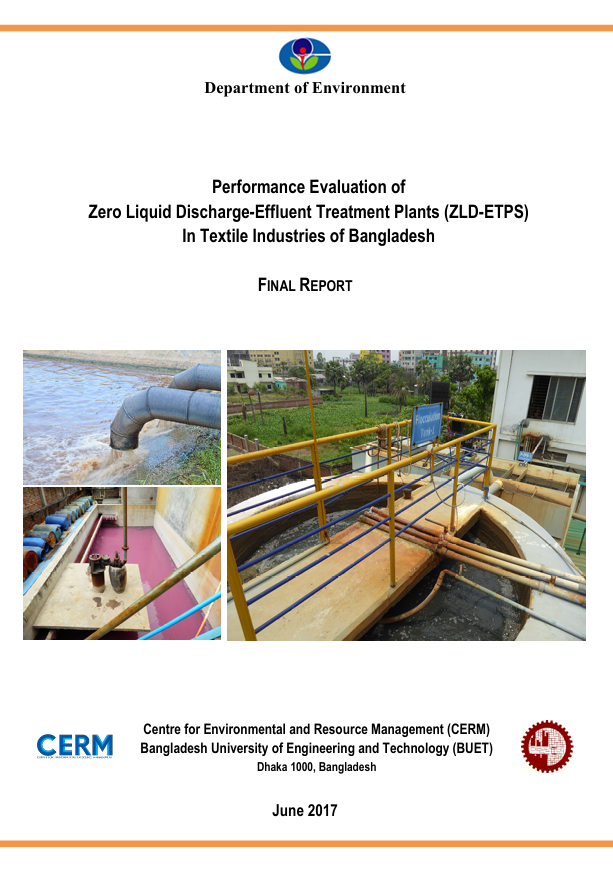
The report titled “Performance Evaluation of Zero Liquid Discharge–Effluent Treatment Plants (ZLD-ETPs) in Textile Industries of Bangladesh” was conducted by the Centre for Environmental and Resource Management (CERM), BUET for the Department of Environment (DoE). The study evaluates the performance of wastewater treatment systems in textile industries and assesses the progress toward achieving Zero Liquid Discharge (ZLD) under the 3R (Reduce, Reuse, Recycle) strategy introduced by DoE in 2014.
The textile sector is one of the most important industries in Bangladesh but also generates large volumes of wastewater containing high levels of organic pollutants, chemicals, and dissolved solids. To address these environmental impacts, industries were required to develop 3R plans aiming to reduce water consumption, recycle treated wastewater, and ultimately achieve ZLD through advanced treatment technologies.
The research reviewed approved 3R plans and conducted field investigations in 20 textile industries, including 10 industries with approved ZLD plans and 10 operating only with conventional Effluent Treatment Plants (ETPs). Wastewater samples were collected from different treatment stages, and data on treatment efficiency, water reuse, sludge management, and operational costs were analyzed.
Findings indicate that while most industries operate ETPs capable of significantly reducing BOD and COD, many facilities still struggle to meet standards for dissolved oxygen (DO) and total dissolved solids (TDS). The study also found that the implementation of ZLD technologies has been very limited; among the industries surveyed, only one industry had installed a reverse osmosis (RO) unit enabling substantial water reuse, while the others had not yet implemented the ZLD components proposed in their plans.
The report concludes that although industries have begun adopting some 3R practices such as water recycling, heat recovery, and rainwater harvesting, full implementation of ZLD systems remains slow due to constraints such as high costs, space limitations, lack of technical expertise, and operational challenges of ETPs. The study recommends strengthening technical capacity, improving ETP performance, and providing clearer guidance and support to industries to facilitate effective implementation of ZLD systems and sustainable wastewater management in Bangladesh’s textile sector.
