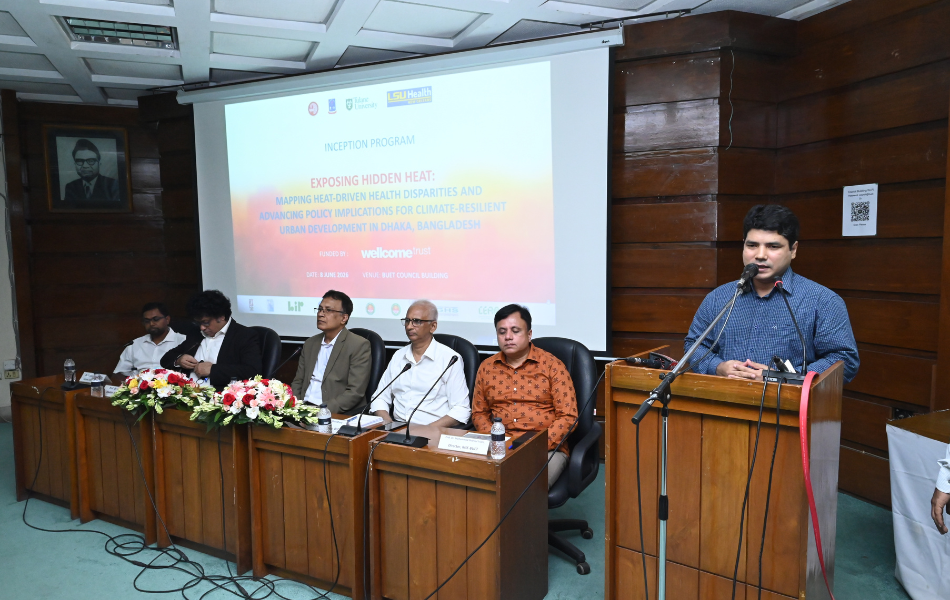
CERM, BUET is going to serve as the Dissemination Partner in Wellcome Trust-Funded Research on Urban Heat and Health in Dhaka.
The Centre for Environmental and Resource Management (CERM), BUET is pleased to be associated with the research project titled “Exposing Hidden Heat: Mapping Heat-Driven Health Disparities and Advancing Policy Implications for Climate-Resilient Urban Development in Dhaka, Bangladesh,” funded by the Wellcome Trust.
As the dissemination partner of this international research initiative, CERM will play a key role in communicating research findings, promoting stakeholder engagement, and supporting the translation of scientific evidence into policy and practice for climate-resilient urban development.
The project brings together an esteemed consortium of researchers from Bangladesh and the United States, including Bangladesh University of Engineering and Technology (BUET), the University of Dhaka, Tulane University, and Louisiana State University (LSU) Health Sciences Center. The research aims to identify hidden patterns of heat exposure and associated health disparities across Dhaka through advanced geospatial analysis, remote sensing, thermal imaging, and community-based data collection.
Dr. Mostafijur Rahman from Tulane University, USA is the Project’s Principal Investigator. The BUET research team is led by Prof. Dr. Khandaker Shabbir Ahmed of the Department of Architecture, who is serving as the Principal Investigator. The team also includes Prof. Dr. Sheikh Mokhlesur Rahman, Director of CERM and Professor in the Department of Civil Engineering, BUET, and Dr. Nazmul Huda, Assistant Professor in the Department of Humanities, BUET, as Co-Principal Investigators. Alongside, Dr. Md Shahinoor Rahman from Louisiana State University (LSU) Health Sciences Center and Dr. Fatima Akter, Professor in the Department of Meteorology from University of Dhaka are among top contributor of the project. Bringing together expertise from architecture, civil engineering, environmental management, climate resilience, and social sciences, the team will contribute to advancing innovative, evidence-based solutions for addressing heat-related health disparities and promoting climate-resilient urban development in Bangladesh.
The project represents an important step toward generating evidence-based solutions for addressing the growing challenges of urban heat and public health in rapidly urbanizing cities. Through its dissemination efforts, CERM remains committed to fostering knowledge exchange and supporting climate-informed decision-making for a more resilient future.